
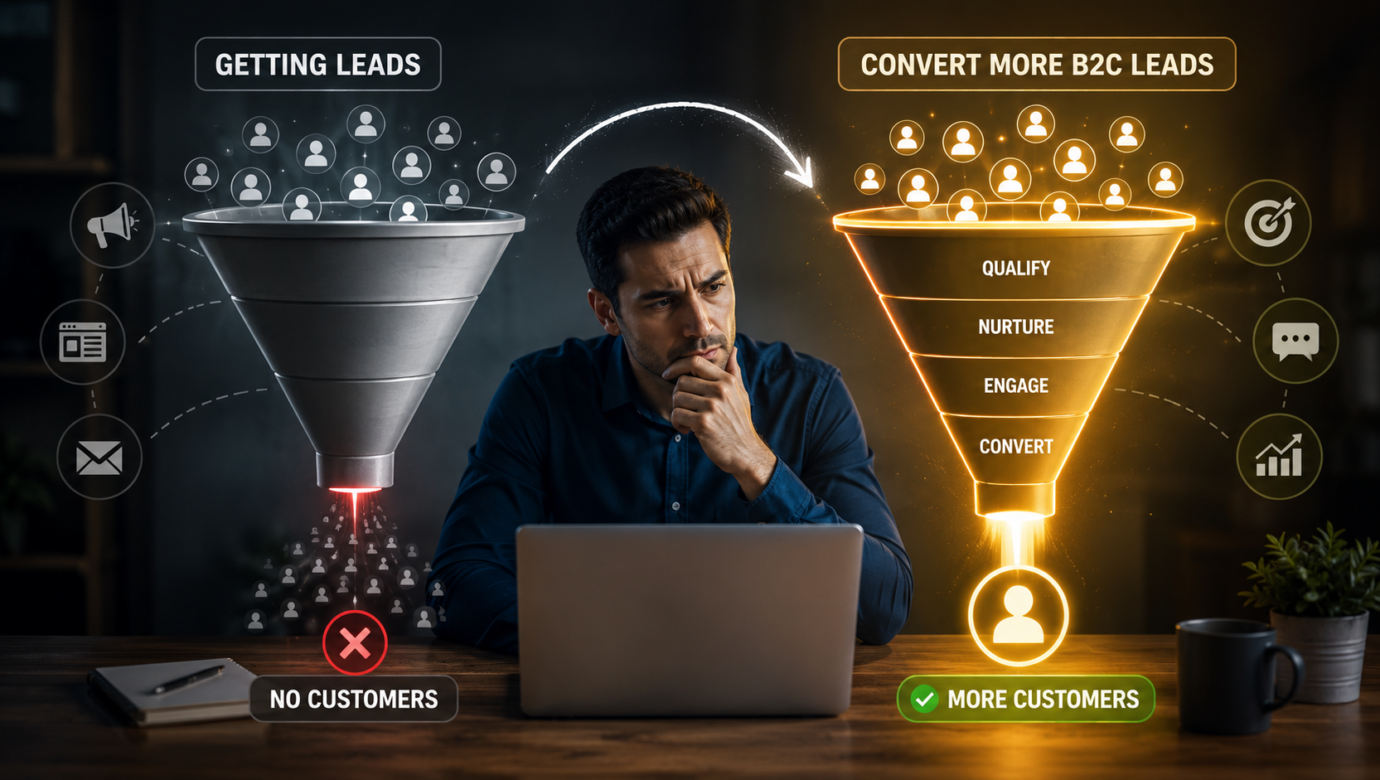
Getting Leads but No Customers? How to Fix Your Lead Generation and Convert More B2C Leads
You are getting enquiries.
People are clicking your ads. They are filling out forms. They are sending WhatsApp messages. Some are even asking about your prices.
Yet, when you look at your sales at the end of the month, something does not add up.
Where did all those leads go?
This is one of the most frustrating problems for business owners today. A company can spend thousands on advertising, generate hundreds of enquiries, and still struggle to turn those enquiries into paying customers.
The natural reaction is to say, “We need more leads.”
But more leads may not solve the real problem.
Sometimes, the business does not need more leads. It needs better lead generation, better targeting, faster follow-up, stronger qualification, and a clearer path from enquiry to purchase.
This is especially important for businesses operating in B2C markets, where customers often compare multiple providers before making a decision.
For example, a travel agency may generate enquiries for a Sikkim tour, Kashmir package, honeymoon trip, family holiday, or international vacation. But an enquiry does not automatically mean a booking.
The real question is:
Are you generating the right leads, and do you have a system to convert them?
Lead Generation Is More Than Getting Enquiries
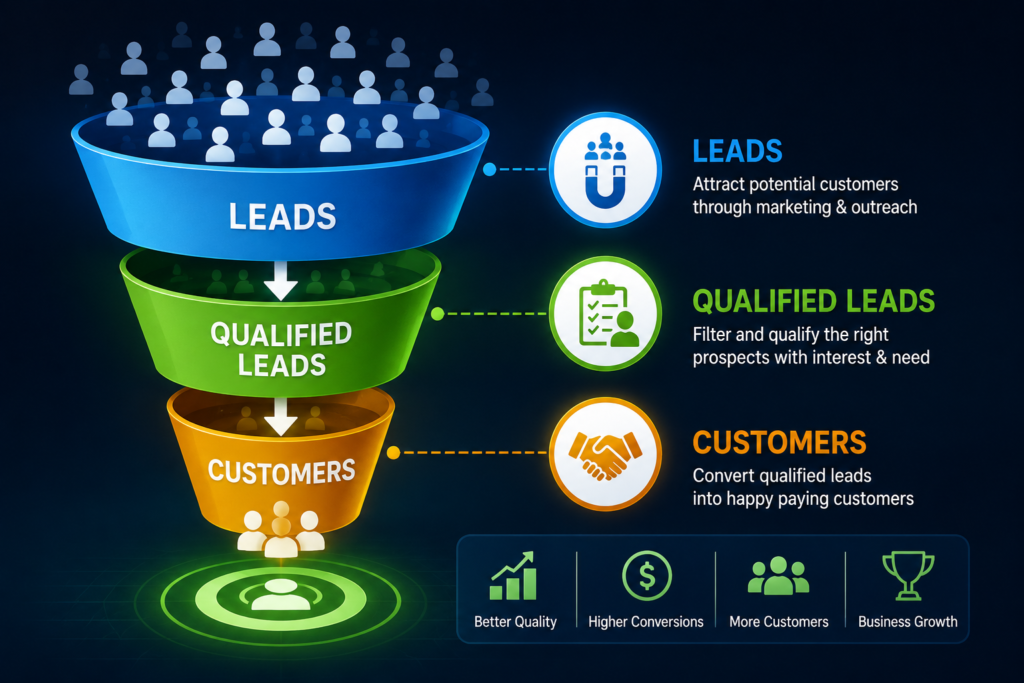
Lead generation is often measured by one simple number: how many leads were generated.
But that number alone does not tell you whether your marketing is working.
Imagine two travel agencies.
Travel Agency A generates 500 leads in a month, but most people are looking for extremely cheap packages, asking only for prices, or are simply researching destinations.
Travel Agency B generates 100 leads, but those prospects have selected their destination, shared their travel dates, explained their requirements, and have a realistic budget.
Which agency has the better lead generation strategy?
The answer is not necessarily the agency with 500 leads.
The second agency may have a much stronger lead-to-customer conversion rate.
This is why modern lead generation should focus on more than volume.
A useful lead generation strategy should consider:
- Who is the customer?
- What problem are they trying to solve?
- What is their budget?
- How soon do they want to buy?
- What motivates their decision?
- What objections could stop them?
- What information do they need before purchasing?
- Why should they choose your business instead of a competitor?
When these questions are answered, lead generation becomes a business growth system rather than simply an advertising activity.
Why Are Your Leads Not Converting?
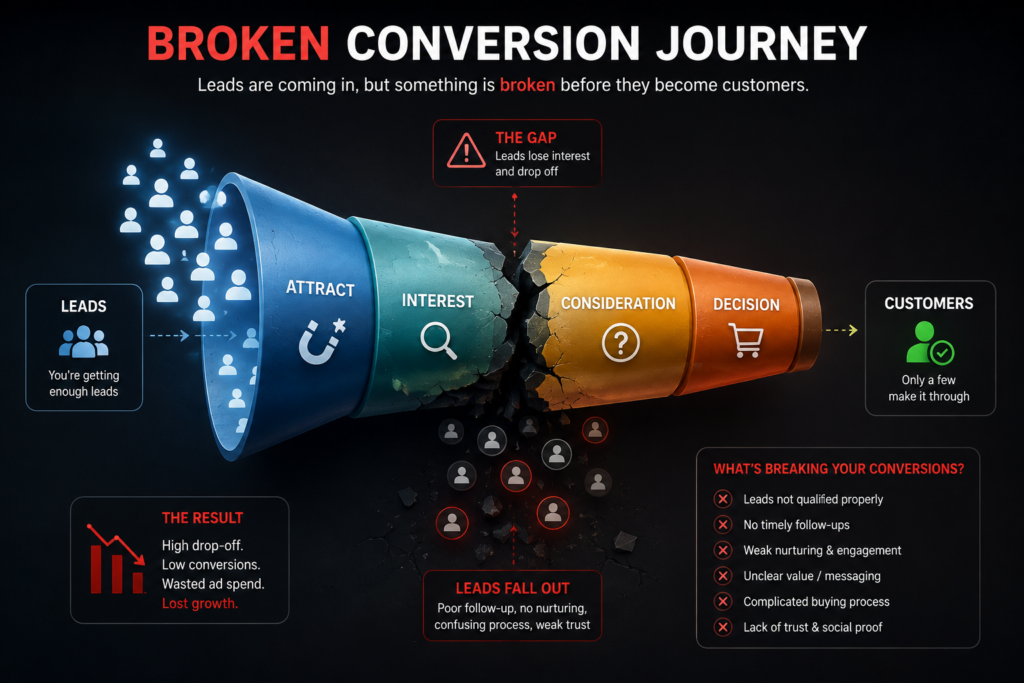
There can be several reasons.
The biggest mistake is assuming that every lead has the same buying intention.
Someone searching for a holiday package today may be ready to book.
Another person may simply be comparing prices.
Someone else may be planning a trip six months from now.
Another prospect may have clicked an advertisement because the destination looked attractive but has no actual intention to travel.
All four people can become leads.
But they are not equally valuable.
This is where lead quality becomes important.
1. Your Lead Generation Is Too Broad
Broad targeting can produce impressive lead numbers.
But if your audience is too broad, your sales team may spend most of its time talking to people who were never the right customers.
For B2C lead generation, audience segmentation can make a significant difference.
Instead of targeting everyone interested in travel, a travel agency could create separate audiences around:
- Honeymoon holidays
- Family vacations
- Luxury travel
- Budget travel
- Adventure trips
- International holidays
- Weekend getaways
- Corporate travel
- Group tours
- Destination-specific holidays
Each audience has different motivations.
A honeymoon traveller may care about privacy, romantic experiences, hotels, and personalised service.
A family may care more about safety, convenience, child-friendly accommodation, transportation, and value.
A luxury traveller may care less about finding the cheapest package and more about comfort, exclusivity, and experience.
When your lead generation strategy reflects these differences, your advertising message becomes more relevant.
And relevance can improve lead quality.
2. You Are Generating Interest, Not Buying Intent
One of the most important differences in lead generation is the difference between interest and intent.
Interest means someone is curious.
Intent means someone is moving toward a buying decision.
For example:
“Best places to visit in Kashmir” shows interest.
“Kashmir 6-day private tour for two people in October” shows much stronger intent.
The first search may belong to someone researching destinations.
The second could belong to someone actively planning a purchase.
This does not mean low-intent users are worthless. They may become customers later.
But your business should understand the difference.
A strong B2C lead generation funnel can separate prospects according to their stage in the buying journey.
For example:
Awareness → Interest → Enquiry → Qualification → Consultation → Proposal → Follow-up → Purchase
The goal is not simply to push everyone directly toward a sale.
The goal is to understand where each prospect is and give them the right next step.
3. Your Offer Does Not Clearly Explain the Value
Sometimes the problem is not the lead.
It is the offer.
A customer may ask:
“Why should I choose this company?”
If your website, advertisement, landing page, or sales message does not answer that question clearly, the customer has little reason to move forward.
This is particularly important in competitive industries such as travel.
A customer can find dozens of agencies offering similar destinations.
If every business says:
“Best packages.”
“Affordable prices.”
“Book now.”
“Unforgettable experience.”
the customer may struggle to understand what makes one provider different.
A stronger value proposition focuses on a specific customer outcome.
Instead of simply selling a “Sikkim package,” a travel agency could position the experience around a specific customer need, such as a privately planned Himalayan holiday with comfortable stays, personalised transportation, and an itinerary designed around the traveller’s preferences.
The exact offer will depend on the business.
But the principle remains the same:
Customers need to understand the value before they are willing to pay for it.
4. Your Lead Qualification Is Weak
Not every enquiry deserves the same sales approach.
This does not mean ignoring people.
It means understanding their requirements.
For a travel agency, useful qualification questions could include:
- Where do you want to travel?
- What are your preferred travel dates?
- How many people are travelling?
- What type of trip are you planning?
- What is your approximate budget?
- Do you prefer private or group travel?
- Have you already selected accommodation?
- When are you planning to make a booking?
These questions help turn an anonymous enquiry into a potential customer profile.
The same principle applies to other B2C businesses.
Qualification helps identify high-intent leads and allows sales teams to prioritise their time.
This can also improve the quality of feedback going back to the marketing team.
Instead of saying:
“We generated 300 leads.”
the business can say:
“We generated 300 enquiries, 120 were qualified, 60 requested proposals, and 18 became customers.”
That tells a much more useful story.
5. Slow Lead Follow-Up Can Cost Sales
Imagine someone enquires about a holiday package.
They are excited.
They are comparing options.
They want information.
Then they wait.
Hours pass.
Maybe the business responds the next day.
By that time, the customer may have already contacted five competitors.
This is why lead follow-up is an important part of lead generation.
Generating the lead is only the beginning.
The next stage is responding quickly, understanding the requirement, answering questions, and moving the prospect toward a useful next step.
For travel businesses, that next step could be:
- A customised itinerary
- A package recommendation
- A consultation call
- A WhatsApp conversation
- A hotel comparison
- A quotation
- A booking discussion
The exact process depends on the business.
But the principle is simple:
A lead has value only when your business gives that lead a reason to continue.
6. Your Follow-Up Is Too Generic
Another common problem is sending the same message to every prospect.
“Hello sir, please let us know if you are interested.”
That is not a strong follow-up strategy.
A better follow-up uses the information the customer has already provided.
For example:
“Based on your October travel dates and preference for a private Sikkim trip, we have prepared an itinerary that includes…”
Now the conversation feels personal.
Personalisation is especially valuable in B2C lead generation because customers want to feel that the business understands their specific requirement.
Your follow-up should answer the question:
Why should this prospect take the next step with us?
7. Customers Do Not Trust You Enough Yet
Even when your lead generation is working, customers may hesitate because they do not know whether they can trust your business.
This is especially important when the purchase involves a significant amount of money.
Travel customers may worry about:
- Whether the agency is genuine
- Whether the hotel will match the promise
- Whether transportation will be reliable
- Whether hidden charges exist
- Whether the itinerary will actually be delivered
- What happens if plans change
- Whether previous customers were satisfied
Trust signals can reduce these concerns.
Useful trust-building elements include:
- Genuine customer reviews
- Testimonials
- Travel photographs
- Case studies
- Clear package details
- Transparent inclusions and exclusions
- Business information
- Frequently asked questions
- Clear contact information
- Professional website experience
- Real customer experiences
Trust is not simply a branding exercise.
Trust can directly influence conversion.
Travel Agency Lead Generation: Why Enquiries Don’t Always Become Bookings
Travel is one of the clearest examples of the difference between lead generation and lead conversion.
A travel agency may run Facebook or Instagram advertisements for a destination.
The advertisement generates enquiries.
But the sales team discovers that many prospects only want to know the price.
Others are comparing three or four agencies.
Some have no confirmed travel dates.
Some have a budget that does not match the advertised experience.
Others are interested but planning their trip months later.
This is not necessarily a failed campaign.
It may indicate that the campaign is attracting a mixture of intent levels.
A better travel agency lead generation strategy should connect the advertisement, landing page, qualification process, and sales follow-up.
For example:
Advertisement → Destination-specific landing page → Qualification form → Instant acknowledgement → Sales follow-up → Custom itinerary → Proposal → Follow-up → Booking
Every stage has a purpose.
The advertisement creates interest.
The landing page builds relevance.
The form qualifies the prospect.
The sales conversation discovers requirements.
The proposal communicates value.
The follow-up addresses hesitation.
The final stage converts the opportunity into revenue.
That is a lead generation system.
B2C Lead Generation Requires Understanding the Customer Journey
B2C customers rarely move from seeing an advertisement to buying immediately.
They may research.
They may compare.
They may ask friends.
They may check reviews.
They may visit your website.
They may return to your social media page.
They may speak to another company.
They may wait.
This means businesses need to think about the complete customer journey, not just the first click.
A useful B2C lead generation strategy should answer questions at every stage.
Before the enquiry
Why should the customer pay attention?
During the enquiry
Why should the customer trust you?
During the sales conversation
Why is your offer relevant?
After the quotation
Why should the customer choose you?
Before purchase
What objection is stopping the decision?
This approach helps businesses identify where leads are being lost.
Stop Measuring Lead Generation Only by Lead Volume
Lead volume is useful, but it should not be your only metric.
Businesses should also examine:
Cost per lead
How much are you paying to generate each enquiry?
Cost per qualified lead
How much does it cost to generate someone who actually matches your target customer?
Lead-to-customer conversion rate
What percentage of leads eventually become customers?
Close rate by source
Which advertising channel generates customers rather than just enquiries?
Sales cycle
How long does it take to turn a lead into a customer?
Average customer value
How much revenue does a converted customer generate?
These metrics provide a much clearer picture of marketing performance.
For example, a campaign producing leads at a very low cost may look successful.
But if almost nobody purchases, the cheap leads are not necessarily valuable.
Another campaign may produce fewer leads at a higher cost but generate significantly more customers.
That campaign could be much more profitable.
The Goal Is Better Lead Generation, Not Just More Leads
This is the mindset shift every business owner should consider.
If your sales are weak, do not automatically increase your advertising budget.
First diagnose the problem.
Ask:
Are we reaching the right audience?
Are we communicating the right offer?
Are our leads showing buying intent?
Are we qualifying enquiries properly?
Are we following up quickly?
Are we building enough trust?
Are customers clear about what happens next?
Which lead sources actually generate customers?
Once you identify the weak point, you can improve the system.
Sometimes you need better targeting.
Sometimes you need a better landing page.
Sometimes you need a stronger offer.
Sometimes the problem is sales follow-up.
Sometimes the business is generating plenty of leads but not enough qualified leads.
And sometimes the marketing is working perfectly, but the sales process is losing the opportunities.
How LeadROI Partner Approaches Lead Generation
At LeadROI Partner, the focus should not be simply on making businesses collect more enquiry forms.
The bigger objective is to help businesses think about the entire journey from marketing attention to qualified opportunity to customer.
For businesses looking for lead generation services, this means looking beyond surface-level metrics.
A successful lead generation strategy should connect:
Target Audience + Offer + Advertising + Landing Page + Qualification + Follow-Up + Conversion
When these components work together, businesses have a better opportunity to generate leads that are relevant to their products or services.
For travel agencies, that could mean focusing on travellers with specific destinations, dates, budgets, and travel requirements rather than simply maximising enquiry volume.
For other B2C businesses, the same principle applies.
The right strategy depends on the customer, product, buying cycle, market, and business objective.
Your Next Lead May Not Be the Problem
If your business is generating leads but struggling to generate customers, do not immediately assume that you need more traffic.
Your real problem may be hidden somewhere inside the conversion process.
Maybe your targeting is too broad.
Maybe your offer is unclear.
Maybe your leads have low buying intent.
Maybe your qualification process is weak.
Maybe your sales team responds too slowly.
Maybe your follow-up stops after one message.
Maybe customers do not have enough trust.
Maybe your marketing promises one thing while the sales process communicates something completely different.
These problems can make even a large lead-generation campaign underperform.
The solution is not always more leads.
Sometimes the solution is better leads, better qualification, better follow-up, and a better conversion system.
That is the difference between simply generating enquiries and building a lead generation engine that contributes to actual business growth.
Final Takeaway
Lead generation should never be judged only by how many people fill out a form.
The real question is:
How many of those leads have the potential to become customers?
For travel agencies and other B2C businesses, this distinction is critical.
A thousand low-intent enquiries can create more work without creating proportional revenue.
A smaller number of relevant, qualified, high-intent prospects can create a much stronger sales pipeline.
So before increasing your advertising budget, look at the complete system.
Understand your audience.
Improve your offer.
Target buying intent.
Qualify prospects.
Respond quickly.
Follow up consistently.
Build trust.
Measure conversion.
And most importantly, connect your lead generation strategy to business revenue, not just lead volume.
Because the ultimate goal of lead generation is not to collect contact details.
It is to create meaningful opportunities that can become real customers.
