

Marketing Roadmap for Small Businesses: How to Create a Marketing Plan That Generates Leads
A travel agency owner in Kolkata may have great holiday packages, years of experience, and a steady stream of referrals—but still struggle to generate consistent enquiries online.
The problem is often not the service. It is the lack of a clear marketing direction.
One week the business is considering Google Ads. The next week it is posting on Instagram. Then someone recommends SEO, a new website, Meta Ads, branding, or content marketing. Before long, the budget is spread across several activities without a clear idea of what is actually generating customers.
This is where a marketing roadmap for small business becomes valuable.
A marketing roadmap helps connect your business goals, target audience, offer, website, marketing channels, lead generation process, budget, and performance metrics into one practical strategy.
For businesses in Kolkata and across India, it can be particularly useful when competition is high and every marketing rupee needs to work harder.
What Is a Marketing Roadmap?
A marketing roadmap is a practical framework that explains where a business wants to go, which marketing activities should be prioritized, and how success will be measured.
Instead of treating SEO, Google Ads, Meta Ads, social media, branding, and website development as separate activities, a roadmap connects them to a larger business objective.
For example, a travel agency may want to generate more enquiries for international holiday packages.
Its marketing roadmap might connect destination-focused content, Google Search campaigns, Meta advertising, a dedicated travel agency website, WhatsApp enquiries, lead qualification, and sales follow-up.
The purpose is not to use every marketing channel.
It is to identify which activities deserve attention first and why.
Why Small Businesses Need a Marketing Roadmap
Large companies often have dedicated marketing departments, specialists, agencies, analytics teams, and significant advertising budgets.
Small businesses usually do not have that luxury.
A business owner may be responsible for sales, customer service, operations, finance, and marketing at the same time. Spending hours deciding whether to invest in SEO, Meta Ads, Google Ads, website development, or branding can become a distraction from running the business.
A clear marketing plan helps answer practical questions:
- Who are we trying to reach?
- What are we trying to sell?
- What makes our offer different?
- Where are potential customers searching?
- What should our website do?
- How much should we spend?
- What counts as a qualified lead?
- Which numbers should we track?
- When should we increase or reduce spending?
This is especially important in India’s increasingly digital advertising environment. FICCI-EY reported that digital advertising in India reached ₹947 billion in 2025 and accounted for 63% of total advertising revenues.
For a small business, the lesson is not simply to spend more on digital marketing.
It is to make sure the digital activity has a clear connection to business results.
How to Create a Marketing Plan for a Small Business
A good marketing plan starts with the business rather than the marketing platform.
First, define what you actually want marketing to accomplish.
That could mean generating more enquiries, increasing bookings, launching a new service, entering a new city, reducing customer acquisition costs, increasing repeat business, or improving online visibility.
The goal needs to be measurable.
“Get more customers” is a direction.
“Generate 50 qualified enquiries per month for our holiday packages” gives the marketing team something concrete to work toward.
The next consideration is the customer.
A business should understand who it wants to attract, what problem that customer has, what they are searching for, what influences their decision, and what could stop them from buying.
For a travel agency, this could mean understanding the difference between a family looking for a budget holiday, a couple searching for a honeymoon package, and a corporate client planning group travel.
These audiences may require completely different messages and offers.
Your Marketing Channels Should Have a Purpose
One of the most common small-business marketing mistakes is choosing channels simply because everyone else is using them.
Google Ads, Meta Ads, SEO, social media, content marketing, email, branding, and website development can all be useful.
But they do not all solve the same problem.
Google Search can be particularly valuable when customers already have a clear intention.
Someone searching for “Kolkata travel agency” or “honeymoon packages from Kolkata” is demonstrating a different type of intent from someone casually watching a travel video on Instagram.
Meta Ads can be useful for creating awareness, showcasing products visually, reaching relevant audiences, and remarketing to previous visitors.
SEO can help businesses build long-term visibility for searches related to their services, problems, locations, and products.
A website provides the destination where much of that traffic eventually needs to convert.
The right marketing roadmap therefore does not ask, “Which channel is best?”
It asks, “Which channel is best for this audience, offer, stage of the buying journey, and business objective?”
Your Website Is Part of Your Marketing Strategy
A business website should do more than provide an address, company history, and list of services.
It should help visitors make a decision.
This is particularly important for a travel agency website.
Someone arriving on a travel website should quickly understand what the agency offers, which destinations it covers, what types of packages are available, why the agency can be trusted, and how to request more information.
A strong travel agency website may include destination pages, holiday package pages, customer reviews, FAQs, itinerary information, clear enquiry forms, WhatsApp integration, click-to-call functionality, and strong calls to action.
Mobile responsiveness is equally important.
A customer researching a holiday on a smartphone should not have to zoom in, search through complicated menus, or complete a long form just to ask for an itinerary.
A visually attractive website is useful.
A website that converts relevant visitors into conversations is much more valuable.
Travel Lead Generation Starts Before the Enquiry
Travel lead generation is not simply about running an advertisement and collecting phone numbers.
The customer journey usually starts much earlier.
A traveller may discover a destination on social media, search Google for package options, visit several websites, compare prices, read reviews, discuss the trip with family, and return later before contacting an agency.
That means a travel agency lead generation strategy needs to account for multiple stages of the decision-making process.
Search can capture existing demand.
Social advertising can create interest.
SEO can answer research questions.
A travel agency website can provide information and build trust.
Remarketing can bring previous visitors back.
WhatsApp and phone calls can turn interest into a conversation.
Sales follow-up can turn the conversation into a booking.
The strongest systems connect these activities rather than treating them as separate campaigns.
Travel Agency Marketing in Kolkata and India
Kolkata provides an interesting market for travel businesses because agencies can serve both local customers and customers from wider regions.
A Kolkata travel agency might target people searching for local travel services, domestic holidays, international packages, honeymoon trips, family vacations, religious tours, or customized itineraries.
At the same time, an online-first travel company may be able to target customers throughout India.
The strategy should therefore reflect the actual service area.
A business serving customers in Kolkata may benefit from local search optimization and location-specific landing pages.
A travel company selling packages nationally may need broader search campaigns, destination-focused content, and nationwide advertising.
Adding “Kolkata” to every page or keyword is not a strategy.
Understanding where the customer is and what they are searching for is.
A Travel Agency Website Should Turn Interest Into Action
Imagine someone searches for a Thailand holiday package and reaches a travel agency’s website.
If the page only says “Welcome to our travel agency” and provides a generic phone number, the visitor has little reason to continue.
A stronger page might immediately explain the destination, package options, approximate duration, inclusions, traveller benefits, customer reviews, and next steps.
The visitor should be able to:
View Package → Request Itinerary → WhatsApp → Speak to an Expert
The same principle applies to other services.
Whether the business sells education, professional services, healthcare, home services, software, or travel, the website should make the next action obvious.
B2C Lead Generation Is About Quality, Not Just Volume
For many small businesses, generating leads is only half the problem.
The other half is generating the right leads.
Suppose one campaign produces 300 enquiries at a low cost.
Another produces 100 enquiries at a higher cost.
The first campaign may appear to be the winner.
But if most of those 300 people are price shoppers while the second campaign produces serious buyers, the cheaper campaign may actually be costing the business more.
This is why B2C lead generation should be evaluated beyond cost per lead.
Businesses should look at:
- Qualified enquiries
- Sales conversations
- Conversion rates
- Customer acquisition cost
- Revenue
- Customer value
- Booking value
- Repeat purchases
For travel agencies, a qualified lead might be someone who has a realistic travel timeline, destination interest, approximate budget, and genuine intention to plan a trip.
That information is much more useful than simply knowing someone submitted a form.
Meta Ads and Google Ads Should Work With the Funnel
Meta Ads and Google Ads are powerful acquisition channels, but advertising alone does not create a complete lead-generation system.
Consider a travel agency running an advertisement for a Bali package.
The advertisement generates a click.
What happens next?
If the visitor lands on a slow or confusing page, the advertising budget is wasted.
If the page is good but the enquiry form does not work properly, the opportunity is lost.
If the enquiry arrives but nobody responds quickly, the customer may contact another agency.
If the sales team responds but cannot identify the customer’s budget or travel dates, the conversation may go nowhere.
This is why performance marketing needs to be viewed as a chain:
Advertising → Website → Enquiry → Qualification → Follow-Up → Sales → Booking
Improving one part while ignoring the others can limit the result.
Common Marketing Mistakes Small Businesses Make
One of the biggest mistakes is running advertising without knowing what success looks like.
If the only objective is getting clicks, a campaign can look successful while generating little business.
Another mistake is targeting everyone.
A broad audience may create cheap traffic but poor-quality leads.
Businesses also frequently invest in a new website without defining what the website should accomplish.
A website should have a purpose.
If the goal is lead generation, its pages, messaging, forms, calls to action, and tracking should support that goal.
Ignoring follow-up is another major problem.
A high-quality lead that receives no response for several hours may no longer be a high-quality opportunity.
Businesses can also waste money by constantly changing campaigns before collecting enough information to understand what is working.
Marketing requires testing, measurement, and patience.
The Importance of a Marketing Roadmap Before Spending More
Many business owners know they need marketing but do not know where to begin.
Should they improve the website first?
Should they hire an SEO company?
Should they run Meta Ads?
Should they use Google Search?
Should they invest in branding?
Should they create content?
Should they build landing pages?
There is no universal answer.
If the website is difficult to use, increasing traffic may simply increase wasted traffic.
If the website converts well but nobody finds it, acquisition may be the priority.
If the business already receives leads but does not follow up effectively, the sales process may be the biggest opportunity.
A marketing roadmap for small business helps identify these priorities before money is committed to random activities.
A Practical Marketing Roadmap for a Kolkata Travel Agency
Consider a hypothetical travel agency based in Kolkata that wants to increase enquiries for customized international holidays.
The agency could begin by defining its ideal customers, selecting a few profitable destinations, creating dedicated destination and package pages, and setting up clear enquiry and WhatsApp CTAs.
Google Ads could target relevant high-intent searches.
Meta Ads could showcase destination experiences and package offers.
SEO content could answer questions travellers ask before booking.
Visitors who do not enquire could be considered for remarketing.
New enquiries could be qualified based on destination, dates, number of travellers, and approximate budget.
The agency could then measure qualified enquiries, counselling or sales conversations, bookings, and revenue.
This is a hypothetical example, not a claim about a LeadROI Partner client.
The important point is that the roadmap connects the individual marketing activities to a business outcome.
Build Your Free Marketing Roadmap
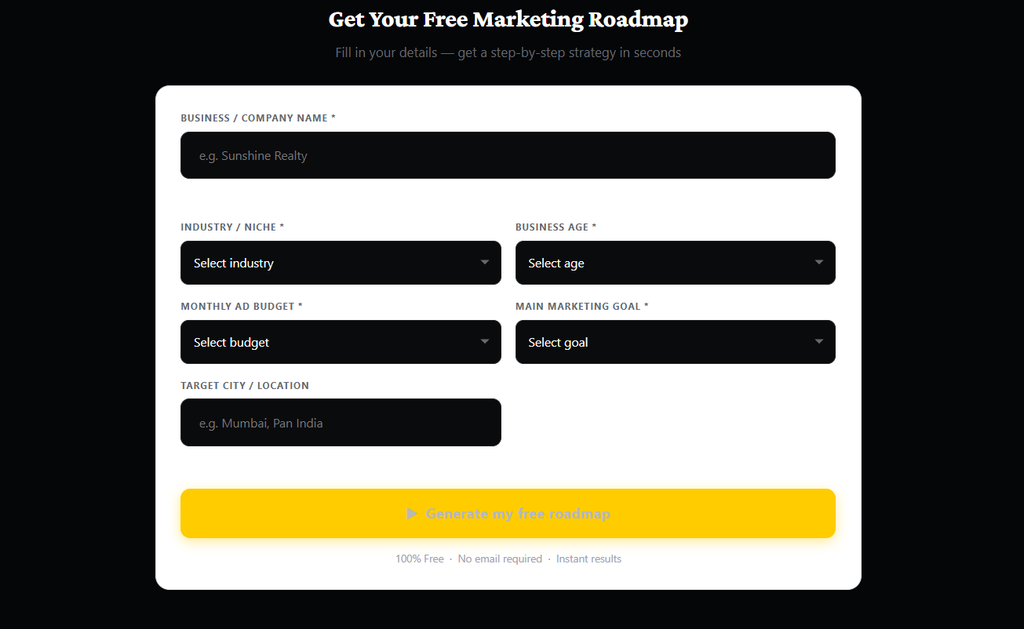
If you know your business needs marketing but are unsure which activity should come first, LeadROI Partner offers a free Marketing Roadmap tool.
It can help you organize your marketing priorities around your business goals, audience, channels, campaigns, and next steps before you start increasing your marketing spend.
It is particularly useful for small business owners who do not want another generic list of marketing tactics—they want a clearer starting point.
Build Your Free Marketing Roadmap →
The tool is a planning resource, not a substitute for understanding your customers or measuring actual business performance.
How to Improve Your Marketing Strategy Over Time
A marketing plan should not remain unchanged for twelve months.
Markets change.
Customer behaviour changes.
Competitors change.
Advertising costs change.
Your own products and offers change.
A better approach is:
Plan → Launch → Measure → Learn → Improve → Scale
Start with a clear objective.
Launch a focused campaign.
Measure meaningful results.
Find out what is working and what is not.
Improve the weakest part of the funnel.
Then scale the activities that produce profitable outcomes.
For example, if a travel agency discovers that a particular destination page generates fewer enquiries but significantly more bookings, that insight should influence future content, advertising, and budget decisions.
Marketing becomes more effective when decisions are based on evidence rather than assumptions.
Simple Marketing Plan Checklist
- Define a measurable business goal
- Identify your ideal customer
- Create a compelling offer
- Research customer search intent
- Choose priority marketing channels
- Review your website
- Create conversion-focused pages
- Set a realistic marketing budget
- Define qualified-lead criteria
- Set up conversion tracking
- Create a fast follow-up process
- Measure leads and customers
- Review performance regularly
- Improve before scaling
Frequently Asked Questions
How do I create a marketing plan for a small business?
Start with your business goal, target audience, offer, marketing channels, website, budget, lead-generation process, and KPIs. Then create a simple sequence showing what needs to happen first, what comes next, and how success will be measured.
What is a marketing roadmap for a small business?
A marketing roadmap is a prioritized plan that connects business objectives with marketing activities. It helps small businesses decide which channels, campaigns, website improvements, and lead-generation activities deserve attention first.
How can a travel agency generate more leads?
Travel agencies can combine Google Search, Meta Ads, SEO, destination content, travel package landing pages, remarketing, WhatsApp, and fast sales follow-up. The right combination depends on the agency’s destinations, audience, budget, margins, and sales process.
How can a travel agency website generate leads?
A travel agency website can generate leads by presenting clear destination and package information, using strong calls to action, adding enquiry forms and WhatsApp, displaying reviews and trust signals, providing useful FAQs, and making the website fast and easy to use on mobile devices.
What is the best marketing strategy for a travel agency?
There is no single strategy that works for every travel agency. Google can capture existing search intent, Meta can support visual discovery and remarketing, SEO can build long-term visibility, and a conversion-focused website can turn visitors into enquiries. These channels work best when connected to a strong follow-up process.
How much should a small business spend on marketing?
There is no universal amount. The appropriate budget depends on customer value, profit margins, sales capacity, conversion rates, competition, location, and acquisition costs. Start with a manageable test budget and increase investment when the data supports it.
Final Thoughts
A good marketing strategy is not a collection of disconnected activities.
It is a system.
Your business goal should influence your audience. Your audience should influence your offer. Your offer should influence your marketing channels. Those channels should lead to a website or landing page designed to convert. The resulting enquiries should be qualified and followed up. And the entire process should be measured against actual business results.
For a Kolkata travel agency, that could mean turning Google searches, social media discovery, and destination research into qualified holiday enquiries and bookings.
For another small business, it could mean turning local searches into phone calls or website enquiries.
The principle remains the same: know what you want to achieve before deciding what marketing activity to buy.
If you are unsure where to start, use the free LeadROI Partner Marketing Roadmap to organize your priorities before investing more time or budget.
