

How to Get More Travel Agency Leads: Proven Tips for Tour & Tourism Businesses
A couple sits on a hotel balcony in Goa, scrolling through their phones and talking about their next holiday. They have already saved a few destinations, watched several travel videos, and compared prices—but they still haven’t decided which agency to trust. Then an offer appears showing a beautifully planned Kerala escape, complete with real photos, a clear price range, and a simple way to request the itinerary. Within minutes, the couple submits their details. For a travel agency, that small action can be the beginning of a valuable customer relationship.
Travel buying has become increasingly influenced by social platforms. Expedia Group’s 2025 Traveler Value Index found that 61% of travelers use social media for trip inspiration, compared with 35% in 2022, while 73% say influencer recommendations have influenced a travel booking decision.
For tour operators and tourism businesses, the opportunity is clear: instead of waiting for travelers to discover your agency, you can put the right destination, experience, and offer in front of people who are already interested in travelling.
1. Sell the Experience, Not Just the Package
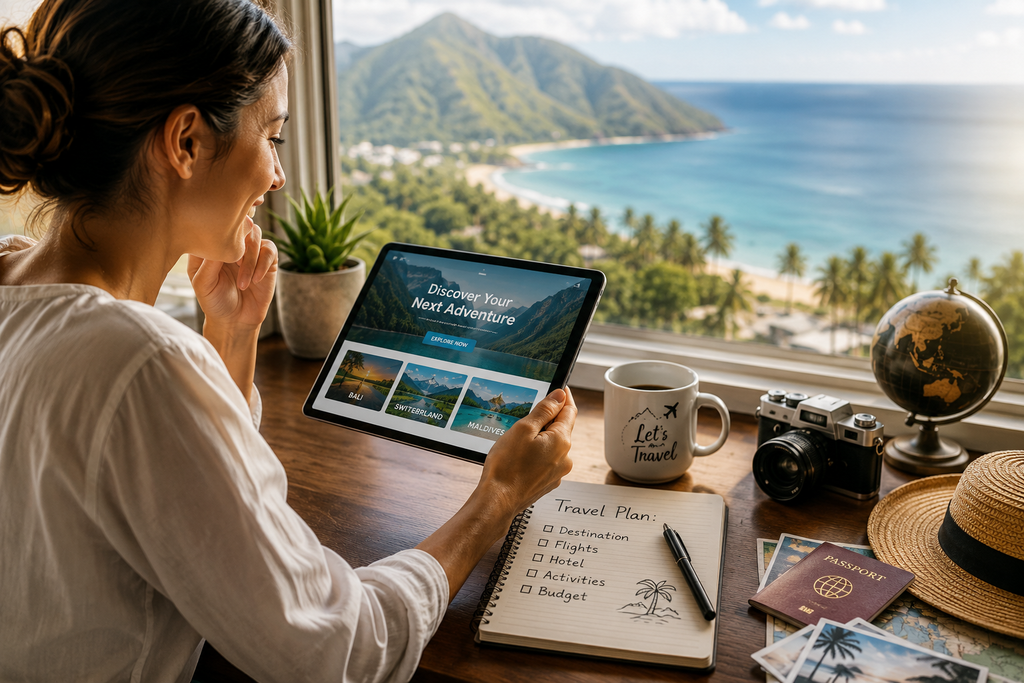
One of the biggest mistakes travel businesses make is creating advertisements that look like price lists.
A traveler doesn’t wake up thinking:
“I need a 5-night, 6-day package.”
They think:
“I want a relaxing honeymoon in Kashmir.”
Or:
“I want to take my family to Sikkim during the holidays.”
Your campaign should therefore start with the experience and problem, not simply the package specifications.
For example:
- “Planning your first family trip to Sikkim?”
- “Turn your honeymoon into a private Kashmir escape.”
- “Want to explore Bali without planning everything yourself?”
- “A stress-free Rajasthan trip for your family.”
The package becomes the solution to that desire.
Expedia’s research supports this approach: among travelers influenced by advertising, 52% said beautiful images were influential, 46% cited promotions or ideas, and 41% valued advertising that highlighted interesting experiences.
2. Use Destination-Specific Campaigns

Don’t try to advertise every destination to everyone.
A person interested in a family holiday in Sikkim may have completely different motivations from someone planning a honeymoon in the Maldives.
Create separate campaigns around:
- Destination
- Travel purpose
- Traveler type
- Budget range
- Season
- Duration
- Departure city
For example, instead of one broad campaign for your agency, create individual offers such as:
- Sikkim Family Holiday
- Dubai Couple Package
- Kashmir Honeymoon
- Kerala Family Escape
- Andaman Luxury Holiday
This makes your advertising message much more relevant.
3. Give People a Reason to Submit Their Details
Getting someone to stop scrolling is only the first step.
You need a compelling reason for them to enquire.
Instead of simply writing:
“Contact us for travel packages.”
Offer something useful:
- Free personalized itinerary
- Free travel consultation
- Destination quotation
- Customized package
- Early-booking offer
- Family holiday consultation
- Honeymoon package consultation
- Free airport-transfer upgrade
- Limited-time package discount
The offer should reduce the traveler’s perceived risk while giving your agency an opportunity to start a conversation.
4. Keep the Form Simple
Travelers are often browsing on their phones.
If your enquiry form asks for ten or fifteen pieces of information, many people will abandon it.
Start with the information your sales team actually needs:
Name
Phone/WhatsApp number
Destination
Travel date
Number of travelers
Approximate budget
You can collect additional information later during the sales conversation.
The objective isn’t to create the longest customer profile possible. It’s to create a qualified conversation.
5. Target Intent, Not Just Demographics
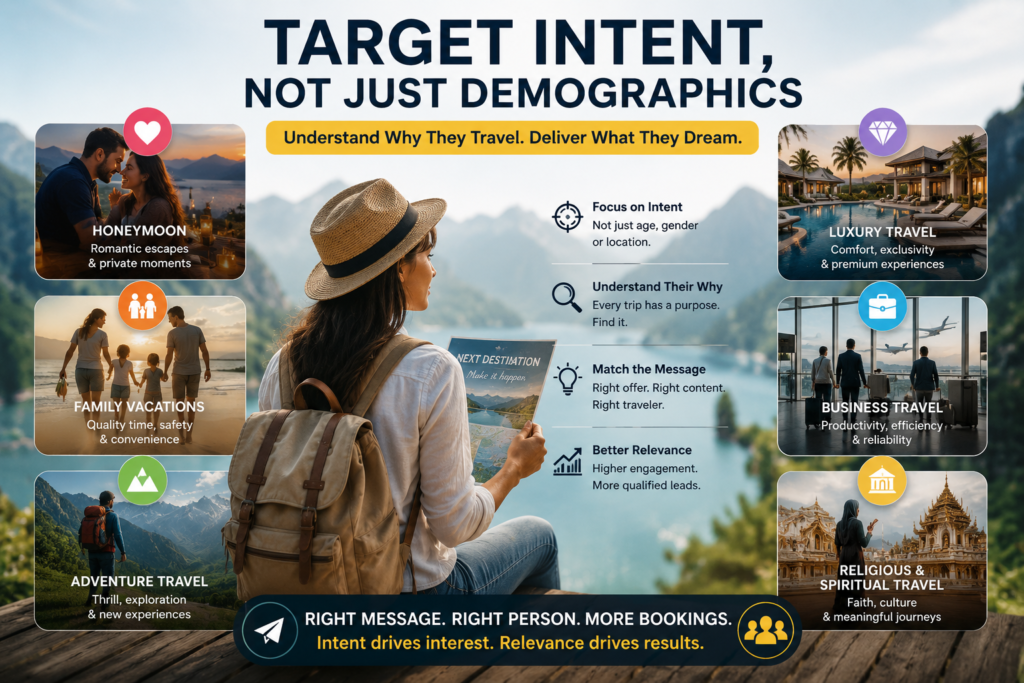
A common mistake is thinking only about age, gender, and location.
Travel campaigns become stronger when you think about why someone might travel.
Consider audiences around:
- Honeymoon planning
- Family vacations
- International holidays
- Adventure travel
- Luxury travel
- Weekend trips
- Group tours
- Corporate travel
- Religious tourism
- Seasonal holidays
Then match the creative to the audience.
A honeymoon advertisement should feel romantic.
A family holiday advertisement should communicate convenience and safety.
An adventure package should emphasize experiences.
A luxury campaign should communicate exclusivity.
6. Make Your Creative Look Like Travel Content
Travel is an extremely visual industry.
A generic banner saying:
“TRAVEL PACKAGE — BOOK NOW”
is unlikely to create the same emotional response as a strong image or short video showing the actual experience.
Use:
- Destination videos
- Hotel room walkthroughs
- Scenic locations
- Customer experiences
- Local activities
- Before-and-after travel stories
- Short destination guides
- Real traveler photos
- Reels showing what the package includes
Expedia’s research found that social media is particularly important during the inspiration phase, with travelers using it to discover destinations, accommodation ideas, deals, and recommendations.
7. Build Trust Before Asking for the Booking
Travelers are spending money on an experience they haven’t had yet.
Trust therefore matters enormously.
Show:
- Google reviews
- Customer testimonials
- Real trip photographs
- Hotel partnerships
- Years of experience
- Destination expertise
- Clear inclusions and exclusions
- Contact information
- Real staff or travel experts
Reviews are particularly powerful. Expedia found that 76% of consumers would pay more for a hotel with better customer reviews, showing how strongly trust can affect travel purchasing decisions.
Your advertisement should not only answer:
“What are you selling?”
It should also answer:
“Why should I trust you?”
8. Follow Up Quickly
Generating an enquiry is not the end of the process.
Imagine someone requests a Kashmir package at 10:00 AM. If your agency responds at 7:00 PM, that traveler may already have contacted three competitors.
Create a simple follow-up process:
- New enquiry → Immediate acknowledgement → Sales call → Package quotation → Follow-up → Booking
You can also segment enquiries into:
- Hot
- Warm
- Cold
- Not qualified
- Booked
This allows your team to prioritize serious travelers rather than treating every enquiry identically.
9. Measure Lead Quality, Not Just Lead Quantity
Suppose Campaign A generates 100 enquiries at ₹150 each.
Campaign B generates only 40 enquiries at ₹300 each.
At first glance, Campaign A looks better.
But imagine Campaign A produces only two bookings while Campaign B produces eight.
Campaign B is actually the stronger campaign.
Track:
Cost per enquiry
Cost per booking
Qualified enquiry rate
Sales conversion rate
Revenue generated
Return on advertising spend
This is especially important for tourism because a single booking can sometimes be worth several thousand rupees—or significantly more for international and luxury packages.
10. Use Retargeting to Recover Interested Travelers
Not everyone books after seeing an advertisement once.
Someone might:
- Watch your destination video.
- Visit your website.
- Look at a package.
- Leave.
- Compare another agency.
- Come back several days later.
- Finally enquire.
Your strategy should account for this journey.
Retarget people who have already interacted with your content or website with messages such as:
“Still planning your Kashmir holiday?”
“Your Sikkim holiday doesn’t have to wait.”
“Get your customized Dubai itinerary today.”
This keeps your agency visible while the traveler is still making a decision.
11. Don’t Compete Only on Price
If your entire marketing strategy is based on being cheaper, competitors can always undercut you.
Instead, communicate your value.
For example:
- Private transfers + better hotels + personalized itinerary + local assistance
can be more compelling than simply:
₹5,000 cheaper.
Travelers are buying convenience, confidence, memories, and experiences—not just transportation and accommodation.
12. Turn Every Enquiry Into Future Marketing Data
Every enquiry teaches you something.
After running campaigns for a few months, you may discover that:
- Honeymoon packages generate more qualified enquiries.
- Families prefer WhatsApp conversations.
- International packages have higher booking values.
- Certain cities produce better customers.
- Some destinations work better during particular seasons.
- Video advertisements generate stronger engagement than static images.
Use this information to improve your future campaigns.
Your best campaign is rarely created on the first attempt. It is usually developed through continuous testing and optimization.
How a Lead Generation Service Can Help Travel Agencies
For a travel agency, running successful campaigns isn’t simply about pressing the “promote” button.
The entire system needs to work together—from audience targeting and creative strategy to enquiry collection, follow-up, and measurement.
A professional lead generation service can help travel businesses build this process around their specific destinations and customers.
At Lead ROI Partner, we help travel agencies and tour businesses develop campaigns designed to attract relevant travel enquiries, improve campaign efficiency, and turn interested travelers into genuine sales opportunities.
The focus should not simply be more enquiries.
The real goal is:
- More relevant enquiries → Better sales conversations → More bookings → Higher revenue.
Conclusion
The travel industry is becoming increasingly social, visual, and experience-driven. More travelers are discovering destinations through social platforms, while trust, reviews, compelling experiences, and personalized offers continue to influence purchasing decisions. Expedia’s research shows that more than 60% of consumers now use social media for travel inspiration, highlighting the opportunity for travel businesses that know how to communicate effectively in these environments.
For travel agencies and tour operators, the winning approach is therefore not simply to advertise a package. It’s to understand the traveler, present the right experience, create a compelling offer, make enquiries easy, respond quickly, build trust, and measure which campaigns ultimately generate bookings.
When these pieces work together, your advertising becomes more than visibility—it becomes a predictable customer-acquisition system.
Is your travel agency ready to turn more travelers’ holiday dreams into real enquiries and bookings?
